The Consumer Intelligence Layer Pharma's Data Stack Is Missing

by
Aden Kebte


How Socialgist's GLP-1 conversational data and Talking Medicines' DrugVoice AI reveal the consumer signals pharma's traditional tools can't reach.
Author: Socialgist | Aden Kebte Contributor: Talking Medicines | Elizabeth Fairley
This article was developed in collaboration with Talking Medicines, who applied their DrugVoice AI platform to Socialgist's GLP-1 Social Conversations dataset.
GLP-1 therapies may be the first consumer-led pharmaceutical category in history. Consumers are discussing these drugs as lifestyle products — comparing brands, debating cost, and sharing behavioral outcomes across forums and communities — at a scale and velocity that traditional pharma intelligence tools were never designed to capture.
That's what became clear when Talking Medicines applied their DrugVoice AI platform to Socialgist's GLP-1 Social Conversations dataset. Socialgist gathered approximately 500,000 pieces of public content from forums, health communities, and review platforms. Talking Medicines then analyzed a formatted sample of 11,000+ records through their life sciences domain trained NLP models, producing a picture of the GLP-1 consumer that existing pharma data sources cannot generate on their own.
You already know what's happening in your brand through IQVIA, claims, and CRM. "What you don't see is how GLP-1s are being redefined in public as lifestyle products, not just medicines. This dataset is the consumer-side layer that completes your existing intelligence stack," says Elizabeth Fairley at Talking Medicines.
What Existing Tools Miss
Pharma data teams rely on proven tools: IQVIA and Komodo Health for prescriptions and claims, CRM for prescriber and patient interactions, Sprinklr or Brandwatch for social monitoring, and brand tracking surveys for quarterly sentiment benchmarks.
These tools tell you what happened. They don't tell you why.
Why are consumers switching from one GLP-1 brand to another? Why did a competitor's share of voice shift in a specific community before it showed up in prescription data? The answers live in public conversations (on forums, in health communities, across review platforms), but most pharma analytics stacks have no structured way to access that signal. Traditional social listening platforms offer dashboards, but they lock the underlying data behind APIs and export limits, making it difficult for data teams to query, blend, or model against it.
What the Blended Analysis Revealed
When Talking Medicines brought the Socialgist dataset into their DrugVoice environment and layered it with their proprietary life sciences domain specific intelligence models, three signals emerged that none of their existing data sources could have produced alone.
The Conversation has Decoupled from its Clinical Origins
The analysis confirmed a shift that pharma insiders sense but rarely quantify: in open consumer conversation, GLP-1s are being discussed almost entirely as weight-management and lifestyle products. Only about 2% of the sampled content touched on diabetes at all.
This pattern appeared consistently across the sample. Consumers are framing GLP-1s as lifestyle tools, not treatments, and the conversation spans health, leisure, food and drink, and personal transformation narratives. That picture does not emerge from indication-driven datasets or brand tracking surveys.
For marketing leaders, the implication is worth examining: if D2C campaigns lead with clinical outcomes while consumers are making decisions based on lifestyle factors, there may be a gap between messaging and audience priorities. "If you look at open consumer data today, the GLP-1 story is already a weight-management story, not a diabetes story," says Elizabeth. "The conversation has moved, and marketing needs to follow."
Dosage and Formulation are Unusually Prominent
Talking Medicines flagged dosage and formulation as "unexpectedly rich" topics in the consumer conversation. This was far more prominent than they'd typically see in their healthcare-focused datasets.
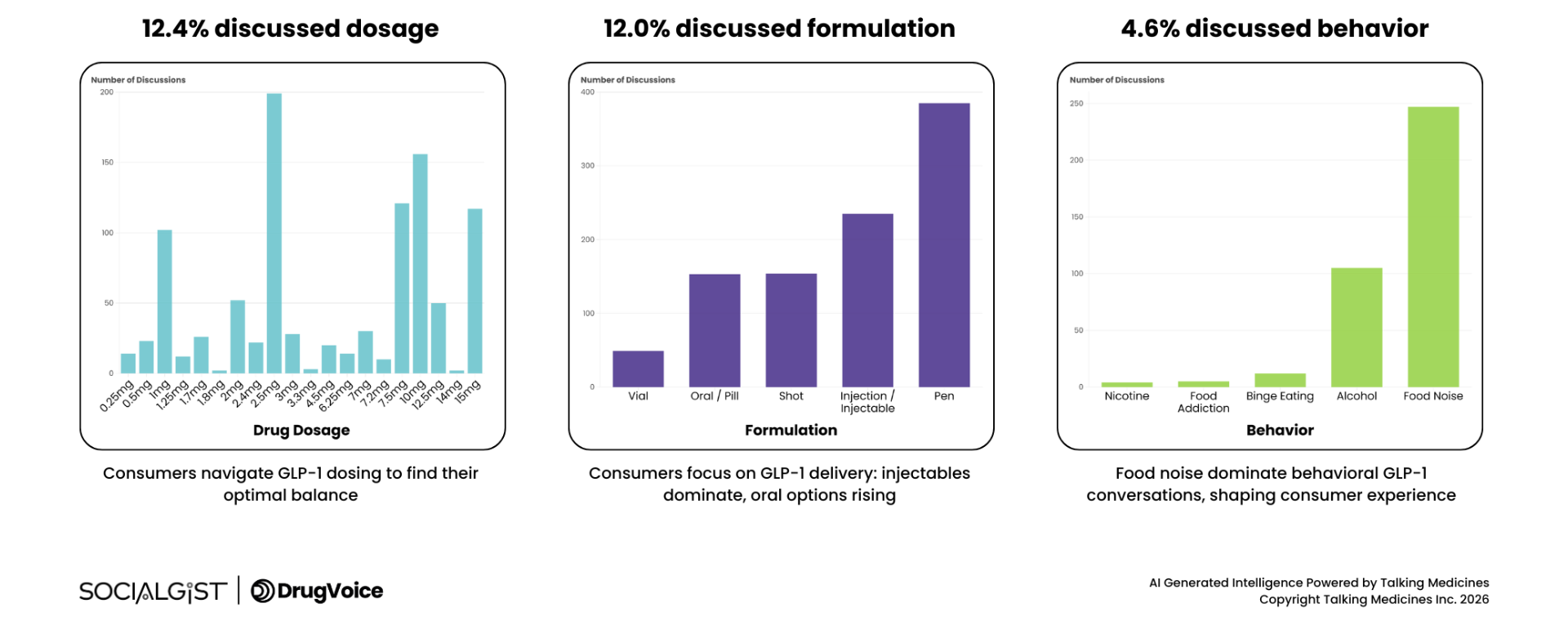
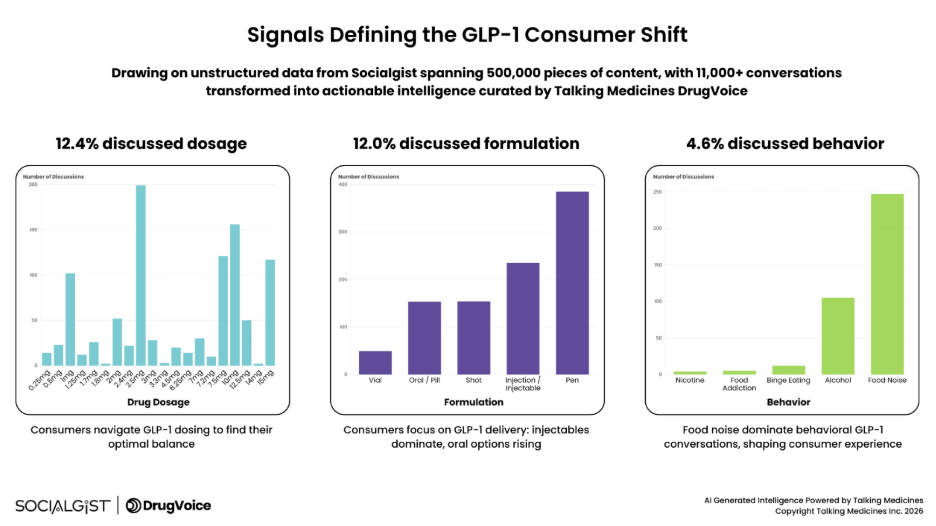
Dosage (12.4% of analyzed conversation): Consumers are actively navigating and negotiating dosing in public, not just with clinicians. The data showed frequent discussion of dose levels, titration strategies, and experimentation. A real-world use-pattern signal that is rarely visible at scale in standard pharma sources.
Formulation (12.0% of analyzed conversation): The conversation around delivery methods is active and evolving. Injections dominate, but oral and vial formats are gaining ground, driven by affordability and convenience concerns. Consumers are comparing pen versus vial, oral versus injectable, and making decisions based on those comparisons.
These signals matter for both data teams building monitoring pipelines and marketing teams evaluating competitive positioning. Traditional social listening dashboards might surface "dosage" as a keyword, but they cannot transform it into a structured, longitudinal indicator with life sciences rigor.
Behavioral Outcomes are the Consumer's Measure of Success
Among the more distinctive findings: 4.6% of the conversations centered on consumer-reported behavioral outcomes that have no equivalent in clinical datasets. This includes food noise, alcohol consumption changes, binge eating patterns, and clothing size milestones.
This is the language consumers use to describe whether their GLP-1 experience is working. Not HbA1c. Not clinical endpoints. Clothing sizes, appetite changes, and lifestyle shifts. These are consumer-reported indicators of experience and perceived value, not clinical measures.
For pharma marketing teams, this language offers a direct window into what resonates with audiences. For data teams, it represents a classification layer that can be built into consumer sentiment models, campaign attribution workflows, and persona refinement processes.
Separating Consumer Voice from Patient Voice
One of the most valuable contributions Talking Medicines’ DrugVoice AI brought to the analysis was their rigor around voice classification. In open conversation, the line between "consumer" and "patient" is blurry: influencers shape expectations, consumers shift into patient territory as they begin treatment, and non-clinical language circulates widely.
Talking Medicines' DrugVoice platform is built to parse these distinctions. Rather than classifying every mention as "patient data," their approach treats the dataset as consumer GLP-1 conversation, with clear pathways to deeper patient and HCP analysis when warranted.
For compliance teams evaluating whether to bring external conversational data into their environment, this matters. The Socialgist dataset is publicly available, PII-redacted, and privacy-safe by design. Talking Medicines' data intelligence layer adds the domain-specific interpretation that pharma teams require, drawing a clear line between what can be observed from consumer voice versus what requires formal patient or clinical data.
What Pharma Data Teams Can Build
Talking Medicines consistently framed the dataset as an additive layer, not a replacement for established pharma data sources. The strongest use cases emerge when you blend Socialgist's consumer signal with IQVIA, claims, CRM, and internal survey data.
Consumer pulse monitoring. Traditional data tells you what happened: script volume, persistence, channel performance. The GLP-1 consumer dataset helps you see why those metrics are moving. Overlay monthly consumer-conversation trends on top of prescribing and adherence data, and you can check whether share-of-voice shifts in open conversation precede or explain changes in demand, churn, or channel performance.
Message resonance measurement. Pharma already tests messages in controlled environments with market research, detail-aid testing, and surveys. The Socialgist and Talking Medicines blend adds unprompted feedback from the real world. Define key narratives (e.g., "first-line for weight management," "metabolic reset," "long-term maintenance") and track how often those messages appear, in what tone, and linked to which brands. Using Talking Medicines' Message Resonance Score(™), teams can measure whether their messaging is landing in actual consumer conversation or whether influencer-driven shortcuts are doing the talking instead.
AI and LLM readiness. For data teams building RAG pipelines, semantic search applications, or custom LLMs, the dataset arrives formatted and AI-ready. Content is pre-chunked for large language models, with thread hierarchy and parent-child relationships preserved. Data teams can index it and start building consumer-facing AI tools — from internal assistants that surface consumer GLP-1 sentiment to marketing tools that search real-world language about specific brands, formulations, or behaviors. Talking Medicines stressed an important boundary: while the dataset is valuable as training and retrieval material for models that need to understand everyday, non-clinical language about GLP-1s, it should be treated as consumer conversation data, not authoritative medical ground truth.
How the Composable Model Works
The collaboration between Socialgist and Talking Medicines illustrates a broader shift in how pharma intelligence environments are being assembled. Rather than buying monolithic platforms that try to do everything, data teams are composing stacks from best-in-class components.
The model has three layers:
Source layer: Socialgist continuously gathers and normalizes large-scale conversational data across platforms. The data arrives PII-redacted, pre-chunked, and formatted with full thread hierarchy. The dataset is portable and ready for any analytical environment.
Intelligence layer: Talking Medicines' DrugVoice platform sits on top as a life sciences AI and data intelligence partner, applying proprietary taxonomy and models (e.g., disease, drugs, formulation, dosage, behavior) to turn unstructured text into structured, analyzable signals. DrugVoice brings a compliance-aware perspective on consumer versus patient versus HCP voices and designs use-case-specific metrics like the consumer GLP-1 pulse and Message Resonance Score(™).
Enterprise layer: The pharma team blends those outputs with IQVIA, claims, CRM, and survey data in their own environment to build dashboards, models, and applications.
"We don't need to be the data pipe and the analytics brain," says Elizabeth. "Socialgist is excellent at getting the right GLP-1 conversations in the right shape into enterprise stacks. We're excellent at asking, 'What does this mean for a pharma team, in a regulated environment?' Those are complementary roles."
This architecture is environment-agnostic. For teams building on Snowflake — and 85% of healthcare leaders now view data interoperability as foundational to scaling AI — Socialgist delivers the GLP-1 dataset as a semantic layer on the Snowflake Marketplace. The data arrives pre-chunked, PII-redacted, and schema-stable, sitting in the same environment where the pharma data team runs their analytics. The free sample listing is designed to minimize engineering overhead, so teams can experiment with the data and evaluate fit before formalizing a commercial relationship.
From Snapshot to Signal
A single analysis produces insight. A recurring feed produces a new kind of instrumentation.
The collaboration explored how a recurring Socialgist-to-Talking Medicines workflow could operate, using January data as a baseline and subsequent snapshots (quarterly, then monthly) to build a time series.
For a pharma team, this unlocks an always-on consumer GLP-1 pulse: month-by-month visibility into shifts in brand share of voice, changes in therapy mix, and evolution of behavioral narratives. With Talking Medicines' Message Resonance Score(™), teams can define specific themes or claims and track whether those messages are gaining or losing traction over time, including how policy or regulatory changes surface in consumer talk.
With recurring refreshes, the dataset becomes less of a one-off insight project and more of a new instrumentation layer on the GLP-1 market, sitting alongside sales, HCP, and patient analytics while bringing the consumer narrative into equal focus.
"In open consumer conversation, GLP-1s are already being treated as weight-loss products first and diabetes drugs a distant second, and you can now measure that shift month by month instead of guessing," says Elizabeth.
Explore the Dataset
The GLP-1 Social Conversations Sample Dataset is available on the Snowflake Marketplace. If your team is already on Snowflake, the listing is designed to minimize integration overhead.
→ Get the GLP-1 Sample Dataset on Snowflake Marketplace and start querying today.
For teams that want to discuss expanded datasets, custom topic configurations, or ongoing data delivery, contact us at socialgist.ai/contact.
To learn more about how Talking Medicines applies life-science AI to conversational data through DrugVoice, visit talkingmedicines.com/drugvoice/.
Socialgist has powered consumer intelligence for the world's leading brands for over 25 years, delivering the largest global collection of human conversation data. Learn more at socialgist.ai/platform.
Data modeling and intelligence findings contributed by Elizabeth Fairley, COO & CDO at Talking Medicines.
.png)